Juice and beverage guide

UHT Machine Selection for Juice and RTD Beverages

Juice and RTD beverage lines need a thermal route matched to acidity, pulp or fiber, dissolved gas, heat sensitivity, package, and distribution plan. UHT is one option, not a universal answer.

A qualified authority should establish the required process for the actual formulation and package; a generic temperature table is not a commercial process specification.

Last updated .

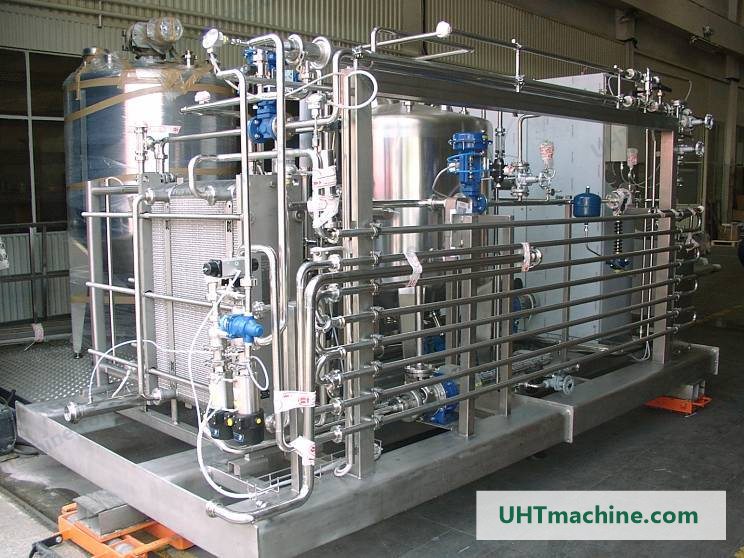
Plate UHT equipment considered for clear juice and RTD beverage duties
Equipment reference for configuration discussion; verify product fit, process duty, package interface, and final delivered scope with project evidence.

Product classification

Classify the beverage before choosing equipment

Composition and acidity

Record beverage type, pH, soluble solids, pulp or fiber, particle limits, viscosity, oil or protein content, and ingredients that can change the required preservation route. Juice, nectar, tea, coffee, dairy-containing RTD, and plant-containing RTD products create different duties.

Quality sensitivity

Define acceptable color, aroma, flavor, dissolved-gas, sediment, emulsion, and vitamin outcomes. Heating, residence time, deaeration, cooling, and package oxygen exposure should be evaluated as one quality system.

Package and distribution

Identify package material, filling route, filling speed, target shelf life, distribution conditions, and market rules. Compare HTST, hot fill, UHT with aseptic filling, or another validated route rather than assuming one process fits every beverage.

Heat exchanger decision

Match flow geometry to pulp, viscosity, pressure drop, and fouling

The selection should be traceable to product data, trial results, cleaning evidence, heat-recovery targets, and the complete preservation route.

Plate dutyClear, low-viscosity, low-pulp beverages may allow a plate UHT configuration. Confirm channel geometry, allowable particles, gasket and pressure conditions, product loss, and the expected cleaning interval.
Tubular dutyAs pulp, fiber, viscosity, pressure drop, or fouling risk rises, compare a tubular beverage duty using actual rheology and particle data.
Wider flow pathFor thicker or particulate formulations, a tube-in-tube option may be evaluated. Pump selection, particle integrity, hold-up, shear, and recovery remain part of the decision.
Heating methodCompare indirect heating with direct injection or infusion only where the complete steam, flash-vacuum, aroma, dilution, cooling, aseptic, and utility consequences are documented.
Pilot evidenceUse pilot beverage trials to observe color, flavor, fouling, cleaning response, separation, and sample handling. Pilot results narrow equipment choices but do not replace production validation.

Preservation route

Prepare, heat, hold, cool, and package as one controlled system

This is a planning sequence, not a scheduled process. The required critical factors and acceptance limits must be established for the product and package.

  1. 01Mix and condition

    Set formula, stable feed, dissolved solids, pulp or particle distribution, and any extraction or blending boundary.

  2. 02Clarify, filter, or deaerate where required

    Control oxygen, foam, suspended matter, and upstream variability without removing product attributes unintentionally.

  3. 03Heat through the selected geometry

    Use the documented flow range, heat route, recovery plan, pressure limits, and instrumentation for the actual beverage.

  4. 04Hold, monitor, and divert

    Freeze holding-section geometry, actual flow evidence, sensor locations, alarm logic, deviation response, and records.

  5. 05Cool within the sterile boundary

    Protect product quality and sterility through cooling, back-pressure control, valves, and downstream transfer.

  6. 06Balance with buffer and filling

    Coordinate UHT output with package size, filler demand, planned stops, aseptic tank strategy, control handshakes, and cleaning windows.

RFQ checklist

Juice and RTD beverage data to send before quotation

Buyer questions

Juice and RTD questions to resolve before equipment selection

Is UHT the right process for every juice or beverage?

No. Acidity, formulation, pulp, heat sensitivity, package, distribution conditions, target market, and the required validated process determine whether UHT or another preservation route should be evaluated.

Should a juice UHT machine use a plate or tubular heat exchanger?

Clear, low-pulp beverages may allow plate configurations, while pulp, fiber, viscosity, pressure drop, and fouling can lead engineers to evaluate tubular or other geometries. Require product-specific calculations and trial evidence.

Can one UHT system process juice, tea, and coffee?

A shared system may be possible only within a documented product envelope covering flow, heating, cooling, residue, cleaning, controls, and packaging interfaces.

What should I send for a beverage UHT quotation?

Send the formulation, pH, soluble solids, pulp or particle data, viscosity, heat sensitivity, target capacity, package and filler data, utilities, cleaning expectations, and process-authority requirements.